Club History

Lincoln College Rugby Club

The Lincoln College Rugby Club (now officially operating as the Lincoln University Rugby Football Club) has a fascinating history tied to the academic life and agricultural roots of Canterbury. As Christchurch’s second-oldest rugby club, its story is deeply woven into the fabric of New Zealand university sports.

Deep Origins (1881)

The First Match: Just ten months after the School of Agriculture (which later became Lincoln College, and eventually Lincoln University) first opened its doors, a rugby team was organized. On May 14, 1881, the foundational team played its first-ever game against Southbridge—one of the longest-established country clubs in Canterbury.

Early Growth: Because the college initially had a small student body, building a consistent squad was a challenge, yet rugby quickly became inseparable from campus life. By its centennial year as a college club in 1978, it had expanded from that single pioneer team to fielding 15 teams across various grades.

Shifting Unions and the 1981 Golden Year

For the first half of the 20th century, Lincoln competed primarily in the rural Ellesmere Sub-Union. However, as the college expanded and the caliber of its players rose, a shift was required:

Moving to Town (1964): In 1964, Lincoln obtained senior status and made the jump into the highly competitive Canterbury Rugby Football Union (CRFU) town competition.

The Harewood Trophy (1969): Just five years after joining the city competition, Lincoln won the Senior Competition and the Harewood Trophy for the first time.

The Grand Double (1981): The absolute pinnacle of the club’s modern era came in 1981. Lincoln became the first team in five years to capture both major Christchurch trophies—the Trust Bank Cup and the Trust Bank Trophy—in a single season. They also won The Press Cup for the best and fairest senior side.

The Merivale Merger and the “Merlins” Era (1995–2008)

By the early 1990s, the club hit a severe rough patch. Because students finish their degrees and move away, the club suffered from a massive, constant turnover of players. In 1993, a lack of mature, tight-five forwards forced Lincoln to pull out of the senior competition entirely to protect its younger students from getting “whacked.”

The 1995 Amalgamation: To survive, Lincoln University merged with the historic Merivale Rugby Club (founded in 1882), which was facing its own player shortage but possessed premier facilities at Nunweek Park.

The Merlins: For 13 seasons, the combined club competed under the banner of the Merivale-Lincoln University “Merlins”, wearing a blended strip.

Return to Campus & The Modern Era

The merger eventually reached its final whistle on September 25, 2008. With the massive success of Lincoln University’s Sports Scholarship programme, the university realized it needed a completely campus-based identity to nurture its elite athletes closely.

In 2009, the club officially reverted back to its traditional roots as Lincoln University Rugby. Playing as the Lincoln University Rams, the club experienced a massive on-field renaissance in the 2010s and 2020s, dominating the Christchurch premier competition.

Note on a Common Mix-up: There is also a completely separate Lincoln Rugby Club based in the nearby Lincoln township. Formed in 1897, that club wears Red and Black and competes in the Ellesmere Sub-Union, whereas the university club plays in the main Christchurch metropolitan competition.

An Elite Player Legacy

Thanks to its highly regarded agricultural and sports science programs, Lincoln has been a developmental home to over 25 All Blacks. Legendary New Zealand captains like Sir Wilson Whineray, Andy Dalton, and Richie McCaw all proudly claim academic and historic rugby ties to the Lincoln campus.

CLICK IMAGE TO ENLARGE

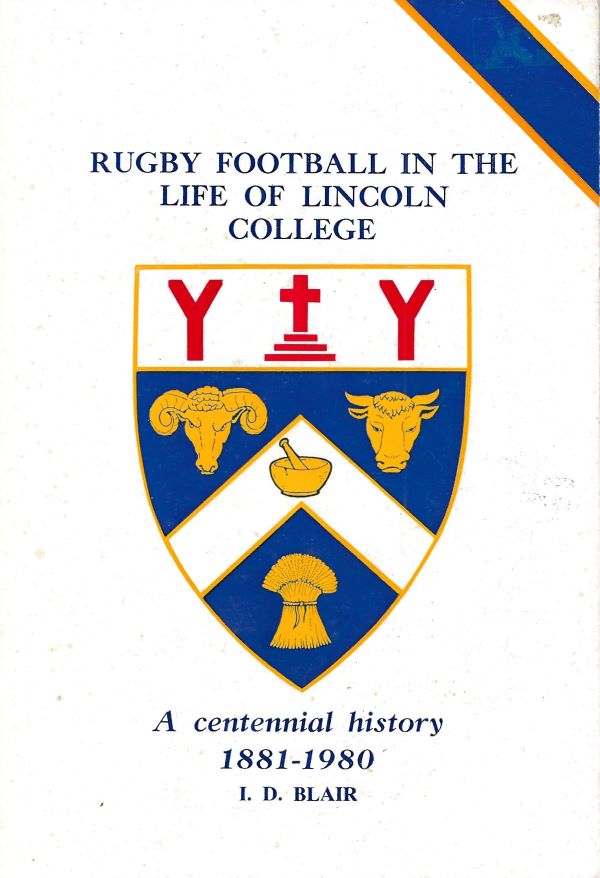
Rugby Football in the Life of Lincoln College – A Centennial History 1881 – 1980

Club:
Year published:
Author:
Page count:
Notes:
Lincoln College Rugby Club
1980
I D Blair
112 pages
CLICK IMAGE TO ENLARGE

Rugby Football in the Life of Lincoln College – A Centennial History 1881 – 1980

Club:
Lincoln College Rugby Club
Year:
1980
Author:
I D Blair
Pages:
112 pages
Notes: